The Power of Hands-on History
The goal of making history compelling isn’t just to memorize dates; it’s to foster historical thinking skills like critical thinking, analysis, empathy, and to create a deep appreciation for the human experience across time. Experiential learning is proven to boost engagement and information retention, and can be used for learners of all ages. When learners can physically handle an object from a specific era, they engage multiple senses, forge a stronger connection, and move from passive listening to active inquiry.
Instead of just reading about a soldier’s experience in the trenches of World War I, a learner can hold a gas mask or a trench mirror and can read letters written by soldiers. This tactile learning experience immediately sparks curiosity, encourages open-ended questions, and allows students to step into the trenches with historical figures, often giving voice to those unheard in traditional narratives. This can also spark interest in nonfiction books, poetry collections, or historical fiction about the featured time period. A well-placed or well-timed “exhibit” in the library to coincide with Veteran’s Day, Pearl Harbor Day, or other major events can connect amorphous events with concrete items and people.
Fostering Community and Local Connection
Because libraries serve as vital community anchors and are often custodians of local heritage, this makes them ideal spaces to showcase local ties to history. Libraries can host special “History Nights” or “Early 20th Century Life in [City/County Name]” where local patrons can investigate and share stories together. Providing opportunities for intergenerational learning, such as grandparents bringing grandchildren or allowing local library patrons to become part of this informal museum space, shows learners that history is not behind glass, but is available for safe, hands-on exploration. This makes history more accessible, allows for librarians to easily support patron interest in historical topics, and encourages patrons to use library resources like genealogy services and special collections.
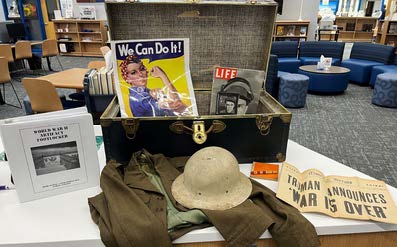
Curating Your Artifacts
Artifacts come in a wide range of sizes, types, and practicality. You can start small with period documents like letters, postcards, propaganda images, or other small paper items that can be authentic and donated by patrons or replicated from high-resolution scans from museums and historical groups.
If you don’t have the funds or time to create your own full-scale footlocker of artifacts, many local museums and historical societies have curated footlockers or educational kits that can be borrowed for free.
By providing these historical artifact footlockers or exhibits, the library reinforces its role as a crucial resource for historical literacy and an active champion of community memory.