Community is Everything
Having a wide network of community connections can help you get more done for and with the people you serve. Regardless of the size of the community you serve, there's a lot of expertise out there, some of which can be showcased in library programs. Happily, most people are honored to be asked to contribute to the success of a library program, either as a paid expert or a volunteer extraordinaire. But how do you know who to approach?
Let’s say you want to start a monthly Saturday adult craft club. Great idea, especially if you are a crafting nerd yourself. If you’re not, no worries, you can absolutely find artsy people in your community, even if no one comes immediately to mind. You (and other programming and outreach librarians if you work at a larger library) might map your community, looking specifically for connections to local crafters and artists.
How to Do a Community Mapping Exercise
Community mapping is an exercise that guides you through a brainstorming session on the relationships you and your coworkers already hold in the community. You can start mapping your community using one of the two methods described below. Better yet, do a mapping exercise with a few of your coworkers at the library and/or a couple of community leaders. In the case of our adult craft club, perhaps it’s a retired school art teacher you map with.
When you do community mapping, make a conscious decision to record just your professional relationships or to record both your professional and personal relationships. Some people like to keep a line between the people they know via work at the library and the people they know as a resident of the community. Understandable. Personally, I take more of a blurred line approach, not making distinctions between how I got to know an individual community member or a local organization. For example, if I’m active in my kids’ Parent Teacher Organization, I am comfortable representing the library at PTO meetings. And at the library, I am comfortable representing the PTO. Either way is good; just decide which approach is more to your liking.
OK. Let’s set the stage for mapping. Alone or in your small group, you can:
- Complete your mapping worksheet together, all working on one template, with one person recording the relationships. You can do this virtually using a Google sheet or Word document on a shared screen or in person using either method described below. If you choose to map your community on a single worksheet, be sure to record who holds which relationships, as this information will come in handy down the road. After completing the joint community map, analyze the results.
- OR you can complete your mapping worksheets ahead of time, share them with each other to review before meeting, and come together virtually or in person ready to talk through the results.
What do I mean by “analyze the results?” Look at the relationships held by the people who have completed the community map(s). Look for duplicate names. Look for missing relationships. By analyzing those community maps together you can determine:
- Who are the movers and shakers in your community?
- Does an individual’s or organization’s name come up over a number of the community maps you and your colleagues completed?
- Is there an individual or community organization that seems to have a lot of connections to the other groups in town?
- Which individuals and groups represent the communities you want to partner with on library programs?
- Who is missing from your community maps?
Movers and shakers are your community’s “yes” people. These folks are busy because they care enough to participate in their community. Don’t be shy about asking a busy “yes” person to join your cause. They’ll probably say “yes!” Plus, they probably bring a lot of local relationships to your project or program.
Who do you want to serve at the library? Perhaps there’s a growing demographic population like Japanese immigrants moving to your community, or the number of young families is on the rise, or a new faith organization was started to serve a growing faith community. This is the kind of information you can find in your Census Reporter data or U.S. Census Bureau Quick Facts site. You can also talk with front-line library staff to anecdotally determine any new demographic groups that seem to be using the library more these days. Knowing this demographic data will help you put on stellar craft programs like origami to attract that growing Japanese population or a holiday art project celebrating Diwali, Lunar New Year, or Eid al-Fitr that might attract a diverse faith community. So many possibilities . . .
Now, let’s get to mapping! There are lots of ways to map your community. I’ll share two methods: one for left-brained and one for right-brained library workers.
A Paper Visual Map for Right-Brained Folks
If you’re a little more creative and prefer a winding and wending approach to the brainstorming process, try this handwritten community mapping exercise, borrowed from WiLS, a library support organization serving more than 600 libraries and cultural organizations in Wisconsin and beyond.
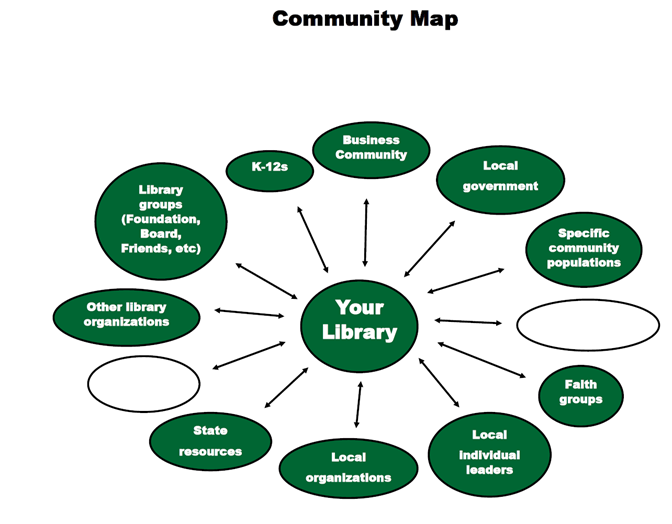
On this paper worksheet you’ll record in the margins of the page the people and organizations you know in each of the categories listed. What you see above is just a template to get you started; feel free to edit the categories to make them fit your community. For example, your town might be known for an annual parade and picnic. So, you could add “Parade organizers” as one of the spokes on the map. If your library is in a college town, you could add “Higher education” to the map. However you choose to structure your map, be sure to leave an empty circle or two for “Other” — those individuals and groups that don’t fit neatly into a single category, or don’t fit into any category at all.
When I was the library director for the Columbus Public Library in Wisconsin, I attended a WiLS session on community mapping. My paper map ended up looking like this:
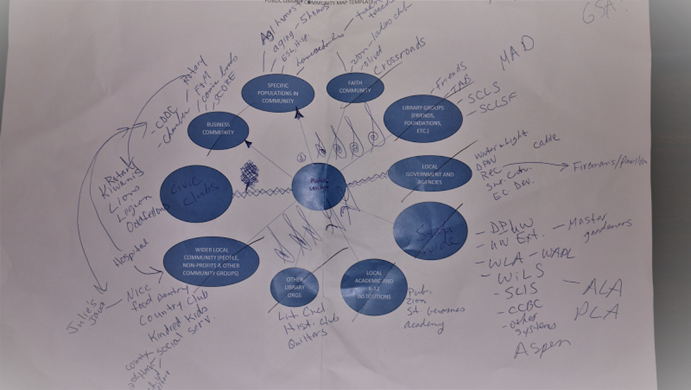
The thing I really like about this method is that you can draw arrows connecting individuals and organizations. For example, you see an arrow connecting Julie’s Java with the NICC Foundation that supports the needs of area residents, including offering holiday arts and crafts programs for children. That’s because Julie, the owner of the local coffee shop in downtown Columbus, helped start the NICC Foundation. In other words, Julie is a “yes” person. It’s often the case that knowing one or two of these local movers and shakers can help you make connections to a number of local organizations and individuals. This method of mapping is a visual record of those relationships.
Pro tip: If you choose to have a community mapping meeting and want to use this paper method, it’s best to have each person complete their own community map, either before the meeting or at the meeting itself. Then you can trade maps to see who the other folks in your meeting know and don’t know.
Here’s a template you can print for your DIY map.
A More Linear Map for Left-Brained Folks
If you prefer straight lines and categorization, this spreadsheet-based community mapping method might be the one for you. You’ll see that the categories are just like those above, just in a row instead of a circle.
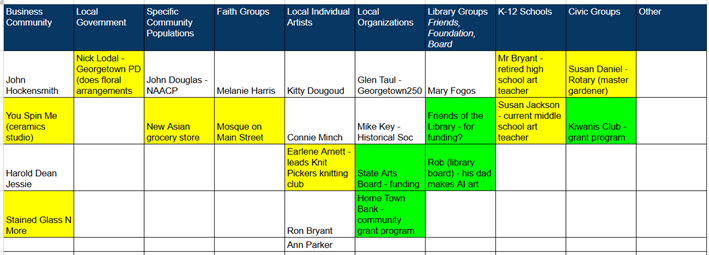
The thing I really like about this method is that I can color code the entries looking for patterns in the relationships. In the example above, knowing we need both funding and art/craft experts for our adult craft club, the potential funders are green and potential experts, or connections to experts, are yellow.
Pro tip: the spreadsheet mapping method works really well virtually. By sharing your screen, you can facilitate analysis of the maps by toggling back and forth between maps people completed and shared before the virtual meeting. Or you can start the virtual meeting with a blank spreadsheet and a brainstorming session. Both ways work great, though the latter method calls for a longer meeting.
Mapping for Saturday Craft Club
Let’s get back to our example of the adult craft club. Either working alone, with fellow library staff, or with a crafting expert in the community, you might use the mapping tools above, but substitute in the following categories:
- Senior crafters
- Previous craft teachers for library programs
- Leaders of the local knitting club
- Local ceramics store
- K-12 art teachers
- Members of the local Arts Council
- Local artists
By recording these relationships, you get a holistic view of the arts and crafts resource people within your community, making it easy to sift through to find a good match for the program you have in mind. Be sure to hang on to the community map(s) you created for the craft club, as you will surely need inspiration and partners for future programs. From there it’s a simple ask of one of those experts to see if they’re interested in hearing more about the program.
When you call, email, or meet with potential community partners, be sure to go into the conversation prepared to answer questions like:
- When is the program? Day, time, does it repeat weekly, monthly?
- Do you pay a stipend? If so, how much?
- Do you have a budget for supplies? If so, how much per program?
- If it’s a series, does it have to be the same expert each time?
Easy, right?
Pro tip: In addition to helping you find program partners, seeking out and developing broad networks via community mapping also:
- contributes to the library’s reputation in the community;
- helps people feel more connected to the library;
- can be tapped to publicly support you when times get tough, like through book challenges, budget cuts, or political infighting; and
- is a key to successful strategic planning.
Expand Your Network With More Community Map Partners
Doing some version of the community mapping exercise is a great way to get to know community partners your library is already working with, as well as those you maybe want to start a new relationship with. It’s also a good way to welcome new staff to the library, by asking them to think about their new job in relation to the connections they already have in the community.
Everything the library does should be informed by community needs, wants, and aspirations. This community mapping exercise will set you on the path toward being responsive and empathetic to community needs.
For more inspiration on serving your community well, check out Chapter 8: Broaden Your Network by Cindy Fesemeyer and Christina Jones, in ALA Publishing's Small Public Library Management.
About Cindy Fesemyer
Helping information organizations see the big picture as they strive for equity and social justice is Cindy Fesemyer's passion as the Principal of Fesemyer Consulting, LLC. Community engagement, qualitative assessment, strategic planning, engaged leadership, and staff training are her areas of expertise. Cindy taught continuing education and academic courses for the UW-Madison iSchool for 10 years and was a Trustee for the Madison Public Library for 8 years. She served 2.5 years at the Wisconsin State Library and 7 years as director of the Columbus Public Library (WI), named a finalist for Library Journal's 2017 Best Small Library in America. Cindy earned her MLIS from UW-Madison in 2012.
ALA identifies Knowledge of the Community as one of nine programming competencies that are vital to successful programs at libraries of all sizes and types.
This article is made possible in part by the Institute of Museum and Library Services grant number RE-256725-OLS-24.