Meetings, meetings, meetings
For many people who work in libraries, days are full of meetings — sometimes too many meetings. Meetings are where a lot of work gets done outside of everyday library operations. Meetings are where we communicate and share information, build relationships, make plans, finalize decisions. Sound familiar?
As a programming librarian, you’re probably a pro at attending meetings in a supporting role. It’s time to take that skill and turn it to your advantage in your programming work.
If you have a cool new idea for a one-off program or a series of programs, chances are you have to “sell” your boss on the idea before you can move forward. When you get permission to move forward, you might also have to work with other library staff and/or community partners to turn your great idea into reality. All this work is likely to occur in meetings. In short, meetings are a necessary part of offering polished, innovative, and creative library programs.
There are three kinds of meetings mentioned above:
- Talking with your boss: one-on-one meeting
- Talking with your coworkers: group meeting
- Talking with community partners: community meeting
All meetings benefit from advance planning. Let's take them one by one.

Talking with your boss
You’re most likely either part of a department, or a department head, or a department of one. Either way, chances are good that you need a one-on-one (1:1) meeting to seek permission to do a program that is different from your library’s usual fare. The goal of a 1:1 meeting is to clearly and succinctly communicate your idea with your boss. It is important to give 1:1 meetings the same pre-planning as any other meeting.
Your 1:1 meeting is the time to discuss program details, set expectations and goals, and identify issues that need to be addressed. Even 1:1 meetings benefit from an agenda because it allows you to prepare ahead of time and engage in productive dialogue and decision-making at the meeting itself.
The agenda doesn't have to be super detailed, but it should flow smoothly from topic to topic. Below is a sample of how you may structure your agenda.
- Numbered items are what’s on the agenda you share ahead of time with your boss.
- Italicized items are an outline of the speaking points you’ll hit during that item.
Sample 1:1 Agenda for a Summer Gardening Series
|
PRO TIP: It is often during these 1:1 meetings that managers discover staff members’ skills and passions. It might help your boss identify professional development and leadership opportunities for you. So, make your meeting matter. 🙂
Talking with your coworkers
Let’s say you get permission to move forward with your gardening series and are allowed to bring a few other people into the mix. Perhaps one is the library marketing person, one is from youth services, and one is from adult services. The next meeting you need to plan is with those staff people. Your meeting is crossing departmental silos, so these people might not be used to working together. That’s a challenge. And you’re up for it!
You want your Summer Gardening Team to get along, communicate clearly, track all the details, and have fun. That means co-creating the program; even though you already have a lot of the details sketched out from your 1:1 with your boss, you need to respect ideas and opinions from the others on the team.
Getting started is easy; write an agenda. Happily, you already have a meeting agenda at the ready. Start with the same agenda you used with your boss, and add a couple more items to get discussion flowing.
Sample Team Agenda for a Summer Gardening Series
|
Talking with community partners
For an ambitious program like the Summer Garden Series, you need experts to teach participants what to do. Perhaps you have a gardening buff on your planning team. If not, you’ll need to find an expert(s) to lead the sessions. That means thinking about community members or your local college extension office as program partners.
A good meeting with a gardening expert requires . . . wait for it . . . a good agenda! This agenda might just be in your head or in a notebook you bring along with you. Or maybe you share it ahead of time so the gardening expert has an idea what to expect when they meet with you. Either way, go into the meeting knowing what you intend to convey and the desired outcome of the meeting. That agenda can be as simple as this:
Sample Community Partner Agenda for a Summer Gardening Series
|
Often when meeting with potential program partners, each group or individual brings their own ideas depending on what they hope to accomplish during the meeting. You can deepen the partnership by using your meeting(s) strategically and investing in building the relationship through clear communication and mutual support.
This may mean having a conversation with your partners about what good collaboration looks like to them. Perhaps you have a handshake deal about what each organization will accomplish on your joint project. If the partnership is expected to last for a long time or if participants want to take the partnership to the next level, you might consider co-creating a Memorandum of Understanding (MOU) that outlines partner expectations, timelines, and deliverables.
However you partner, formally or casually, be sure to clarify expectations on both sides. Partners should agree on what each is offering in terms of resources and what outcomes each partner hopes to achieve. That common understanding will guide the partnership, providing an anchor to revisit if things get off track and ensuring everyone involved feels good about the collaborative work.
That’s a wrap
A meeting facilitator’s job isn't done when the meeting is over. Here’s a checklist of what to do at the end of and after the meeting:
Express Gratitude: While this can be done at the end of the meeting, you should also start any follow-up communication with gratitude. Collaborating is hard work, so it’s important to acknowledge the efforts of the meeting participants.
Summarize: Verbally giving meeting highlights is a good way to conclude the meeting, but that summary should be part of follow-up emails, too. A quick summary helps bring closure to participants and ensure that there is common understanding of what was accomplished, even if that was just to give updates about a project.
Evaluation: Part of closing a meeting is allowing time for some reflection about the meeting related to what worked, what needs attention during the next meeting, and any other questions or thoughts on what meeting participants are excited about. If you’re not super confident in your meeting facilitation skills, you might send out an evaluation after the meeting to get additional feedback.
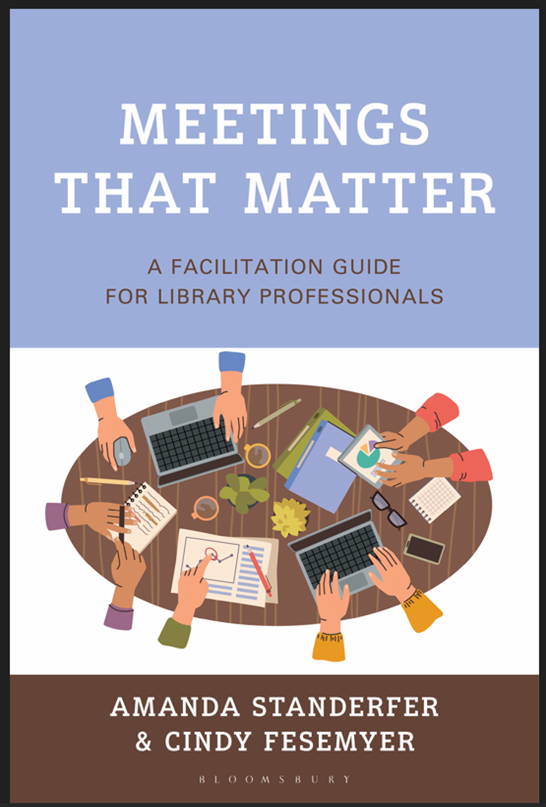
For a lot more meeting facilitation info look for an upcoming book, “Meetings that Matter: a Facilitation Guide for Library Professionals” by Cindy Fesemyer and Amanda Standerfer, from Bloomsbury in early 2027.
About Cindy Fesemyer
Helping information organizations see the big picture as they strive for equity and social justice is Cindy Fesemyer's passion as the Principal of Fesemyer Consulting, LLC. Community engagement, qualitative assessment, strategic planning, engaged leadership, and staff training are her areas of expertise. Cindy taught continuing education and academic courses for the UW-Madison iSchool for 10 years and was a Trustee for the Madison Public Library for 8 years. She served 2.5 years at the Wisconsin State Library and 7 years as director of the Columbus Public Library (WI), named a finalist for Library Journal's 2017 Best Small Library in America. Cindy earned her MLIS from UW-Madison in 2012.
ALA identifies Interpersonal Skills as one of nine programming competencies that are vital to successful programs at libraries of all sizes and types.
This article is made possible in part by the Institute of Museum and Library Services grant number RE-256725-OLS-24.