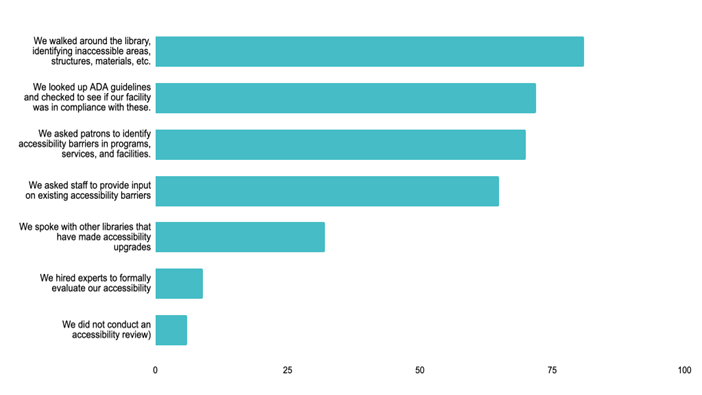
Through the most recent version of its “Libraries Transforming Communities” project, the ALA is providing grants to small and rural libraries to become more accessible to patrons with disabilities. In a recent survey, 96 LTC grantees provided information about their experiences conducting accessibility reviews. Nearly all (94%) said they had done this prior to receiving their grants, and the vast majority (74%) said they had conducted at least three types of reviews. Most often, these reviews were conducted informally and internally, with staff or patrons being asked to provide input on existing accessibility barriers. To identify these barriers, many (75%) libraries also looked up Americans with Disabilities Act (ADA) guidelines, and most (84%) made their own observations while walking around the library. Some respondents (33%) said they spoke with other libraries about the accessibility upgrades they had made, while relatively few (9%) hired a formal accessibility expert to evaluate their programs, services, or facilities.
Regardless of the approach they took, LTC grantees had positive experiences with their accessibility reviews. “I found them extremely helpful,” one said. “Not only were we able to find out what patrons want when it comes to accessibility, but the reviews also made us look at our library through a new lens.” Using very similar language, another said that accessibility reviews "helped us see our library through a different lens and come up with ways to make our library more accessible to all.”
Useful Jumping Off Points: ADA Guidelines and Staff Observations
Libraries often began their accessibility reviews by looking up ADA guidelines. Often, these guidelines provided “important data” for thinking about ways to improve accessibility. But while serving as a “very helpful” jumping off point, libraries sometimes realized that these guidelines offered only a “basic benchmark” for gauging accessibility. “Even though we were technically ADA accessible,” one shared, “many of our spaces weren’t truly accessible to everyone.”
It was for this reason that most libraries sought other means of assessing accessibility. Many found staff feedback productive. Because “they are interacting with patrons daily and see their struggles,” one said, staff were able to “provide much insight” into the library’s accessibility needs. Discussions with colleagues at other libraries were also helpful. One said these discussions were “very helpful” in terms of yielding “practical ideas” about how to become more accessible.
An Essential Step: Listening to and Learning from People with Disabilities
But more than anything else, libraries highlighted the importance of seeking patron input. “Walking the library with ADA guidelines in mind was eye-opening,” one said, “but talking to patrons highlighted the items that were blocking their access.” Along similar lines, a library that had looked up ADA guidance and completed a walk through of their space said that while these efforts were helpful, it was community conversations with patrons that “made the most difference.” “Our efforts showed us many areas for improvement,” another library said—“especially asking our patrons about their needs.”
Often, dialogue with patrons helped libraries learn from others. During a public meeting, one library heard from someone whose church installed a hearing loop system. After this individual shared the congregation’s experience with the technology, staff began looking at other libraries with hearing loop systems, and started researching vendors. “It made all the difference in the world to learn about the experience of others,” they shared.
Another library discovered the value of community feedback when looking into ways to improve an overhead lighting system. During a public meeting, staff learned that the discomfort they had experienced with this system “had a name and a solution.” Highlighting the need to seek patron input, they said that
This kind of feedback was not only validating but transformative for how we think about sensory experiences in the library. These reviews didn’t just help us comply with standards—they helped us understand our space through the lens of our community members with disabilities. That shift in perspective has made all the difference.
An Additional Consideration: Hiring an Accessibility Expert
Relatively few libraries hired outside accessibility experts, but those who did found these reviews to be helpful as well. Some brought in architects or builders to evaluate their facilities and promote ADA compliance. In addition to evaluating their building, one said that an architect had provided different drawings “to get us thinking about how our space could be better utilized.” In another case, a library hired a low vision specialist who put forward “many immediately actionable suggestions”—including a number of “simple, low-cost changes that made a big difference for our patrons.”
Conclusion
The results of our survey indicate that while all accessibility reviews are valuable, those organized around community feedback are critical. Input from people with disabilities provided LTC grantees with “a wealth of information”—both about existing barriers and ways to overcome them. While ADA guidelines, staff observations, and conversations with accessibility experts and other libraries are all important ways to review the current state of a library’s accessibility, there is no substitute for talking with people with lived experiences of disability. As in other matters pertaining to access and inclusion, the best approach is always to put the rallying cry of the disability rights movement into practice: “nothing about us without us.”
About This Article
This article was written by Knology, and is part of a series of blog posts exploring how libraries are using LTC Access funds to better meet the needs of patrons with disabilities. For other posts in this series (including case studies of individual libraries), take a look at Knology’s landing page on the LTC Access project. And for more on how libraries can become more accessible to patrons with disabilities, see the collection of resources Knology assembled.
Does your library have a story to tell about its own accessibility work? Please reach out to us at programminglibrarian@ala.org to share your experiences!