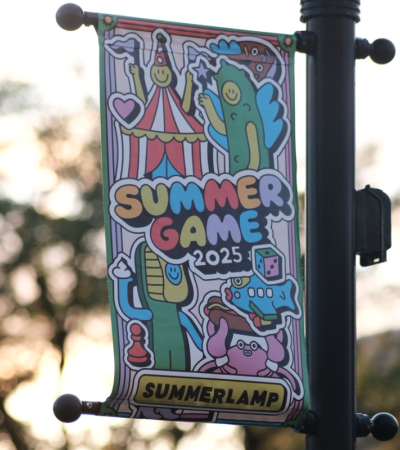
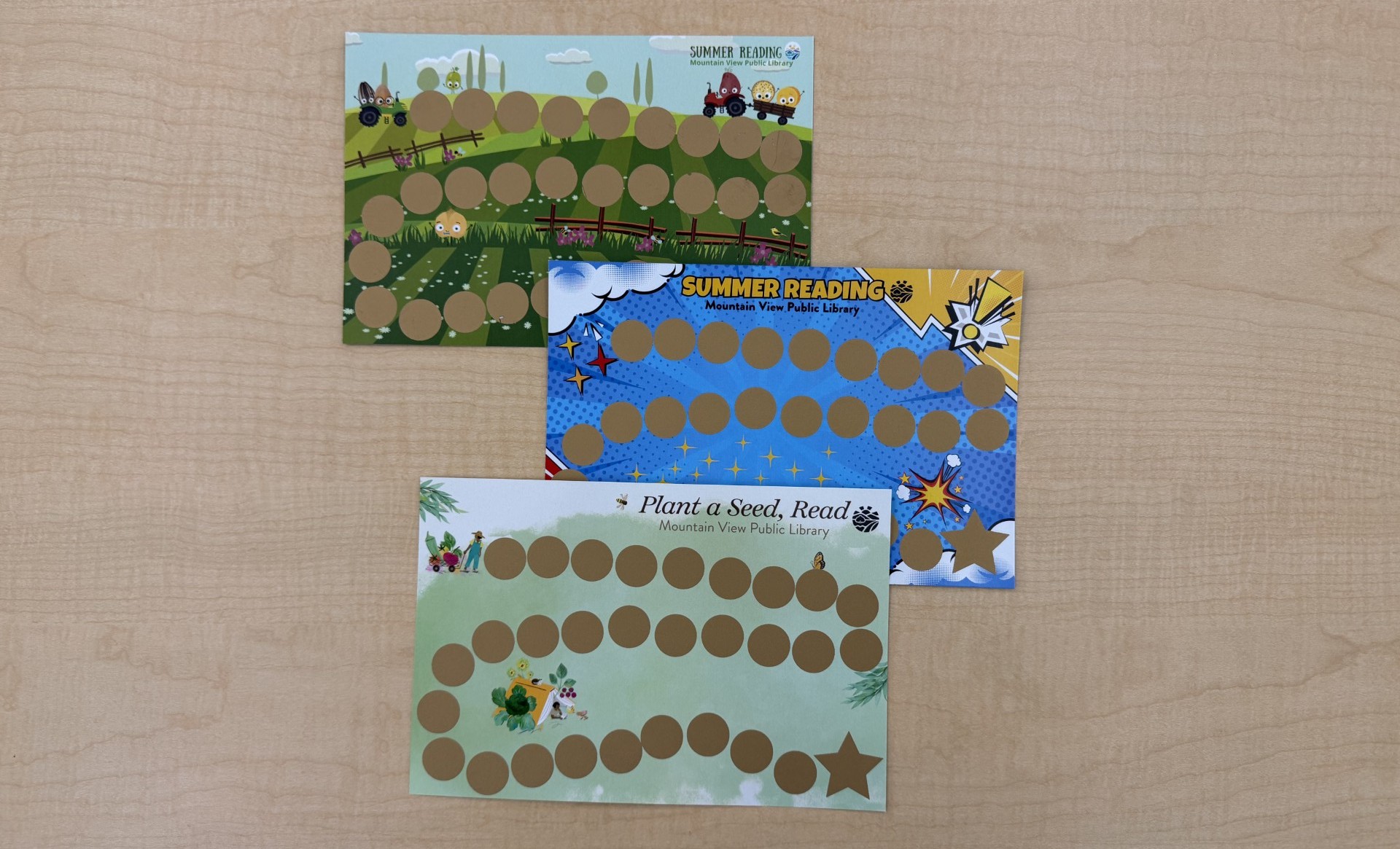
Beginning with our 2025 Summer Reading Program, Mountain View Public Library replaced a traditional reading log with custom scratch-off cards for children, teens, and adults. Participants scratched off spaces as they read, turning the familiar act of tracking Summer Reading into something tactile, playful and a little unexpected.
Advanced Planning
Our goal was to make participation in Summer Reading feel simple, inviting, and fun while maintaining the basic structure of a traditional reading log. We wanted something that could work for a wide range of ages, did not require technology, and added an element of discovery to the experience. Planning began several months before Summer Reading.
Library staff developed separate versions of the scratch-off card for children, teens, and adults and worked with a commercial printer that could apply the scratch-off material. For the children's scratchers, distribution was also part of the planning. Before summer began, we worked with local elementary schools to distribute the scratch-off cards directly to students, so children could take them home before the end of the school year. Instead of asking families to remember to come to the library, register, and then pick up a reading log, children could head into summer with the tracker already in their hands.
One important part of the planning process was determining quantities. We introduced the scratchers for children and teens in 2025 and expanded the program to include adults in 2026. Because the adult scratchers were new, we weren't sure what demand would look like.
Our biggest unexpected challenge turned out to be a good one: the adult cards ran out within the first ten days of Summer Reading, requiring us to place a reprint order during the program.
Marketing
The scratch-off cards became part of our Summer Reading outreach as well as the reading log itself. Before summer began, children's scratchers were distributed to elementary school students in our community, putting Summer Reading directly into children's hands before the school year ended.
This gave us an opportunity to reach children where they already were, rather than relying solely on families coming into the library. The card itself also served as an invitation: it was colorful, tactile, and immediately suggested that there was something to do.
Once Summer Reading began, scratchers were also available at the library and were incorporated into our overall Summer Reading promotion. The unusual format made it easy for staff to introduce the program and generated curiosity among participants.
Budgeting
The primary expense was professional printing of the scratch-off cards. We created the artwork in Canva and sent the completed files to a printer that specializes in scratch-off printing.
For libraries interested in trying the idea on a smaller budget, I would recommend starting with one audience or a smaller pilot quantity rather than producing cards for every age group immediately. A smaller library could also experiment with commercially available scratch-off stickers placed over spaces on cards printed in-house.
One lesson from our experience is to budget for the possibility of a reprint. We underestimated the demand for our adult cards and needed an additional order during Summer Reading.
Day-of-event Activity
Because the scratchers functioned as the Summer Reading log rather than as a one-time event, there was very little special setup required.
Cards were organized by age group and distributed as part of regular Summer Reading registration. Staff needed to understand how each card worked to explain it quickly to participants, but the scratch-off concept was intuitive and required very little instruction.
This was one of the advantages of the project: after the initial design and printing work, implementation could be incorporated into normal Summer Reading operations.
Program Execution
Participants used the scratch-off cards throughout Summer Reading to track their reading progress. Cards were created for children, teens, and adults, allowing the same basic concept to work across our Summer Reading Program.
For children, participation could begin even before they walked through the library doors. By distributing scratchers through local elementary schools before summer vacation, we were able to send children home with a tangible invitation to participate. Children who received a card at school could begin using it over the summer and connect it back to the library. The strongest evidence of interest in the format was the rate at which the cards were turned in for a reward.
The project accomplished what we hoped it would: it took a familiar piece of Summer Reading, the reading log, and made interacting with it more playful without making participation more complicated.
Advice
Keep it simple. The scratch-off element is already the novelty; the rest of the card does not need to be complicated.
When designing the card, keep the layout simple and think carefully about the placement and size of the scratch-off areas. Remember that whatever is underneath will be hidden until it is scratched, so use that element of surprise intentionally and make sure the rest of the card clearly communicates what participants are being asked to do.
Most importantly, don't underestimate the appeal of a small surprise. Summer Reading doesn't always need an entirely new structure to feel fresh. Sometimes changing one familiar piece of the experience is enough to make people curious about participating again.
If you have any questions, please reach out to Renee Kitson (renee.kitson@mountainview.gov).
Supporting Materials
Slideshow Images
More Programs

Camp WannaRead
Audiences:
Summer Reading Décor Secrets
Audiences: